


 The Excel Team
1 min read
Why Use A Courier Service in Virginia, DC & Maryland
Why Businesses Use A Courier Service in Virginia, DC & Maryland Courier service is a fast, safe, and reliable way to get your items where they need...
Updated: July 23, 2026
At its core, a courier service moves various types of materials between locations. A specialized, time-sensitive logistics provider transports high-value, critical, or urgent shipments. Unlike standard postal services, professional couriers utilize a diverse fleet—ranging from bicycles to tractor-trailers—to execute on-demand, point-to-point, scheduled, or routed deliveries that require strict chain of custody and specialized handling.
Because business needs vary, courier and logistics providers generally operate at distinct scales, with specialized capabilities tailored to specific industries. Understanding how these providers structure their operations helps businesses choose the right partner for their supply chain.
Not every courier provider fits neatly into a single category, so it is important to evaluate each provider’s specific capabilities, service model, and operational expertise.
Niche: These providers hone in on a specific market to build deep, specialized expertise. While some providers focus on B2B, B2C, industrial, legal, or administrative courier services, other highly specialized niches require entirely dedicated operational standards. Some examples include:
Healthcare and Life Sciences: Requires strict compliance, including HIPAA and Bloodborne Pathogen (BBP) training for medical specimens, climate-sensitive biologicals, and pharmaceuticals.
Secure Air Cargo & Airport Logistics: Requires TSA-compliant ground couriers with drivers who hold active Security Threat Assessments (STA) to safely and legally tender cargo directly to major airport cargo facilities. (Note: While ground couriers must use TSA-compliant drivers to tender cargo at the airport, only the entity coordinating and booking the actual flights requires IAC certification.)
E-Commerce Home Delivery, White-Glove or Large Goods: Often specializes in residential delivery networks, multi-person lift teams, or basic installation/assembly.
Comprehensive: These providers serve a broad range of industries, with strength rooted in the breadth of their operational capabilities. They often deliver customized third-party logistics (3PL) solutions by coordinating resources across internal teams or external partners to support varied freight and supply chain requirements.
Hybrid: These organizations blend characteristics of both niche and comprehensive operators. Operationally, they maintain specialized divisions, such as healthcare logistics, alongside a broader, general-purpose logistics network. This structure allows a single provider to support a client's standard, high-volume freight while simultaneously executing highly regulated, secure, or time-sensitive deliveries under distinct, specialized standard operating procedures (SOPs).
Key Capabilities and Value-Add Services
Beyond standard transport, courier and logistics providers often offer specialized value-add services to support unique supply chain needs. Understanding these capabilities helps businesses determine whether a provider has the infrastructure for their specific operational requirements.
Warehousing and Inventory Management: Logistics providers utilize warehouse space to streamline distribution, though the type of storage varies significantly:
Critical Parts & Cross-Docking: Focused on rapid-turnaround storage, where replacement parts or medical supplies are stored near key markets for immediate dispatch (often within 2 to 4 hours of an order).
Bulk: Focused on long-term storage and inventory management.
E-Commerce Fulfillment: Focused on high-volume consumer "pick-and-pack" retail services.
Unlike standard shipping providers operating on broad delivery windows, professional couriers specialize in SLA-driven, time-critical logistics where minutes matter. Shipments are dispatched immediately for same-day delivery, often adhering to hyper-specific pickup and drop-off windows.
For example, in healthcare logistics, a diagnostic laboratory may finish collecting patient specimens at 3:30 PM and need every sample at the testing facility by 6:00 PM to support same-day results. A professional courier service meets that requirement with a precise pickup when collections finish, direct transport, and strict chain of custody to help ensure the specimens arrive by 6:00 PM.
In logistics, complete visibility is essential for risk mitigation. Traditional shipping networks rely on hub-and-spoke models where cargo is constantly transferred, sorted, and handled by multiple parties, which significantly increases the margin of error and potential for damage.
A professional courier service minimizes this risk by maintaining a strict, closed-loop chain of custody. Typically, a single dedicated driver handles your shipment from the precise moment of pickup directly to the final delivery point, eliminating intermediary hand-offs.
This custody model is usually supported by advanced tracking technologies, providing stakeholders with real-time security options:
Standard shipping carriers operate on automated, high-volume systems that leave no room for custom instructions or human intervention. When a critical shipment faces an unexpected delay, waiting for a generic chatbot to resolve the issue can disrupt your entire operation.
Advanced courier services offer a high-touch alternative defined by live human communication and precision handling protocols:
Direct Access to a Live Logistics Team: Operations managers and healthcare professionals bypass automated phone trees to communicate directly with the operations team, who can make real-time decisions on critical orders.
Specialized Handling SOPs: Couriers execute highly technical, shipment-specific instructions to ensure product and regulatory compliance. Examples include:
Cold Chain Management: Monitoring and replenishing dry ice or managing gel packs to preserve temperature-sensitive pharmaceutical and biological shipments.
Airway Bill (AWB) Verification: Auditing and confirming complex customs or airport cargo documentation at the point of pickup or transfer.
Last-Mile Protocols: Executing recipient-specific requirements, such as proactive phone calls 15 minutes before arrival or picking up from a laboratory lockbox.
Couriers play an important role in both customer satisfaction and operational stability. Although standard postal services and parcel carriers work well for routine, non-urgent shipments, they are not designed for situations that require faster response times, greater accuracy, and stronger security measures. In mission-critical operations, businesses often need a courier solution that can provide a higher level of control and reliability.
Here's how courier services can benefit you:
However, delivery needs vary. That's why courier services offer a range of solutions, from local deliveries within your city to nationwide and even international shipping.
While courier services may cost more than traditional postal options, the premium features and faster turnaround times make them a valuable investment for time-sensitive or critical deliveries.

Even minor disruptions in shipping can slow a company down. Reliable delivery services help prevent these delays and keep operations running smoothly.
Courier services act as a dependable backup and extension of your team. For example, if an in-house driver is out sick, a local courier can step in to handle critical deliveries. In healthcare, couriers quickly and safely transport urgent medical samples to labs so patients get their results on time.
Many courier companies also offer storage and warehousing. This is highly useful for businesses that do not have enough space for extra inventory, spare parts, or office materials.
To see how these services work together, you can watch the short video below for a quick overview of courier capabilities.
When you ask a third party to deliver and transport items for your business, you want to hire the best courier. To be the best, a courier service must invest in itself—in its infrastructure, people, and courier management technology.

Investing in technology such as GPS tracking, route optimization, specialized courier software, and processes to provide real-time tracking is crucial. Make sure your new courier partner has these capabilities. With these tools, the courier you choose can give you up-to-the-minute feedback. A courier company that cannot do that might not suit your business needs.
The frustrating thing about most courier services is that you don’t know what’s happening with your package until it is delivered. That middle part of the journey, while the package is in transit, can be a black hole that is unsuitable for business!
No two businesses are alike, and therefore, you can’t afford to hire “cookie cutter” courier services. To be great at what a courier does, they have to be adaptable to your needs. Courier offerings can be customized with:
Look for a courier service that hires the right people and is the right size for your needs. Flexibility is important. Make sure you ask the right questions so you’ll know if you're working with a courier who has the capability to flex and fit your needs.

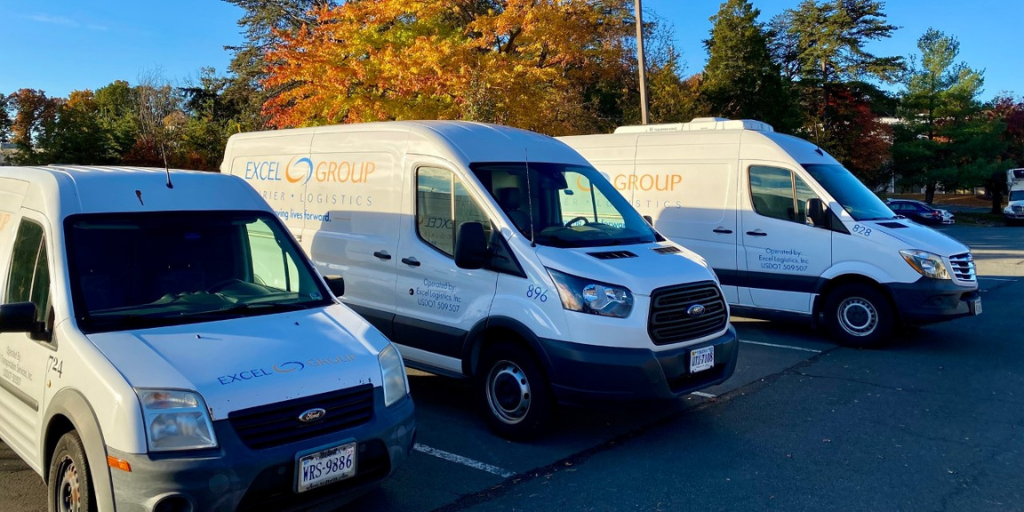
Excel Courier is a warehousing and transportation company located throughout the Mid-Atlantic region. We have locations in five major cities: Ashburn, VA; Sterling, VA; Richmond, VA; and Elkridge, MD. Each location is strategically close to at least one airport and major highways, allowing us to ship across the United States and worldwide.
Our headquarters is located in Ashburn, VA, and from there, we coordinate all our courier and logistics services. Customer service is on-site twenty-four hours a day, seven days a week, 365 days (24/7/365) a year. With one phone call, we can coordinate your pick-up and delivery. You can also opt to log into our portal and communicate that way.
At Excel, we have the resources and expertise. Because of our size and the unique employees we hire, we customize our services to our clients’ needs. This means that we have the flexibility to “deliver” what we promise no matter the project we take on. Working with Excel Courier, you will get a higher standard of customer service than you will from anyone else.
If you are considering your options, give Excel Courier a call!


1 min read
Why Businesses Use A Courier Service in Virginia, DC & Maryland Courier service is a fast, safe, and reliable way to get your items where they need...

1 min read
Mistakes and oversights that occur during a critical medical delivery could result in the loss of life. Right for the shock value! Yes, because in...

1 min read
 The Excel Team : Oct 2, 2025, 3:57:01 PM
Courier services have become essential for companies that need reliable, time-critical transportation solutions. With the global courier market...