



 The Excel Team

Driver Training Built for Healthcare Logistics Networks
So, the question isn’t whether medical courier training should be digital or in-person. It's how to use both to prepare a driver for what happens in the field.
How the driver reacts is where training matters. The method means little if a driver can’t recognize when something isn’t right and apply what they’ve learned.
Ken Arnold, Founder and Instructor at Integrity Medical Courier & Training, knows this well. With decades of medical courier training experience, Ken and his team have seen firsthand where training makes a difference. They are trusted voices in the courier industry, so we asked him to share some perspective on what good medical courier training should actually prepare someone for.
Why Is medical Courier training important?
The rise of at-home healthcare and outpatient procedures, advances in cell and gene therapies, improved patient scheduling technology, and the growing volume of diagnostic testing mean more healthcare materials are moving between more locations.
Despite this growth, one thing hasn’t changed: impact. A specimen may help determine a diagnosis. Medical equipment may be needed by someone waiting at home or preparing to be discharged from the hospital. Research materials may be part of a clinical trial that has taken years to reach that point.
In a 2022 American Nurse survey of 353 nurses, 71% said a medical courier delay or error affected their ability to provide patient care at least once a month. Even more telling, 65% said they had to collect another specimen or sample for testing because of a courier delay or error. Those numbers put some weight behind what can otherwise sound like a simple pickup and delivery.
Responsibility to the patient is also the first thing Ken believes a medical courier should understand before ever handling a shipment:
“Whether it's a blood sample or medications, there is a patient who is depending on the courier to complete the delivery in a professional and timely manner. Mishandling a specimen can ruin it in transit and require a costly, painful re-draw.
Misdelivering someone's medications can be harmful to the patient, especially if they are in a life-threatening medical crisis and are depending on the courier to deliver those medications correctly the 1st time. We've seen several situations where misdelivered medications lead to a HIPAA violation and all the negative consequences therein."
That’s why good medical courier training has to go beyond telling drivers what the rules are. It has to help them understand what they’re carrying and why the procedures exist.
On Screen: digital training adds value
Digital training has made medical courier training considerably more efficient to standardize across a large driver network.
Topics such as HIPAA, bloodborne pathogens, safety procedures, hazardous materials awareness, infection control, and universal precautions need consistency. Digital programs make it possible to deliver that information broadly, document completion, and update training as requirements change.
Because medical couriers may also encounter materials that are:
- Biohazardous or infectious
- Radioactive
- Irreplaceable
- Temperature-sensitive
- Time-critical
- Subject to strict chain-of-custody requirements
There is a lot a driver needs to know before accepting one of those shipments.
But there's another side to online training that deserves attention: who created it and what experience sits behind it. Ken sees this as one of the industry's growing training gaps:
“Honestly, with the advancement of AI, we're seeing more online influencers creating their own OSHA/BBP and HIPAA Courses with no medical background and no real experience in the field. Unfortunately, some couriers see the OSHA & HIPAA Standards as a "box" to be checked off when completed."
A completed course can document that someone received information. The real goal is for the driver to understand it well enough to recognize when and how it applies in an actual delivery.
Digital training provides that foundation very well. Where it gets harder is teaching the gray areas.
When the Answer Isn't on the screen
Most experienced dispatchers and couriers can tell you some version of the same thing: deliveries don't always unfold exactly as written.
An address can be confusing. A lockbox isn't where it's supposed to be. A clinic is closing. Packaging looks wrong. The label says ambient, but the instructions say frozen specimen. Someone at the pickup location tells the driver to do something differently than what they were dispatched to do.
Those are small moments, but in medical logistics, they can have huge consequences. In the same American Nurse survey, 56% of nurses said they had to reschedule a patient procedure in the previous year because of medical courier delays or errors.
A driver needs to be comfortable saying, This doesn't look right. I'm going to check before I move.
Instinct is difficult to teach with a multiple-choice question. It develops through repetition, examples, conversations with experienced people, and, ideally, practice before the driver encounters the situation alone.
There’s also a human side to the job that can be overlooked. Medical couriers don't only interact with loading docks and laboratory staff. Depending on the service, they may meet patients, family members, and caregivers. Those interactions require patience, discretion, and an understanding that the person on the other side of the door may be having a very different kind of day than the driver is.
...Which Is Why Hands-on Training Is Equally Important
One of the useful things about hands-on training is that you can intentionally make things a little imperfect. Put the driver in front of a specimen, walk through a lockbox pickup, or recreate a hospital workflow. Then change something.
What happens if the package doesn't match the instructions? What if the required information is missing? What if a handoff doesn't feel right?
The goal isn't to create every possible scenario because that's impossible. The goal is to develop a driver who notices.
A good courier doesn't need to have every answer. They need to recognize when they don't have the answer and know what to do next. Sometimes the most professional thing a driver can do is stop and make a phone call. That's something we've learned over years of transportation work: speed matters, but knowing when not to rush matters too.
Live shipments shouldn't be where drivers learn that lesson for the first time.
What is the best training model for medical logistics?
Both. The strongest approach we've seen is layered.
Digital training builds the foundation.
It creates consistency around regulations, safety requirements, procedures, and compliance topics.
Hands-on training turns information into practice.
Drivers can handle materials, work through realistic situations, ask questions, and receive immediate feedback.
Ongoing reinforcement and on-the-job exposure keep the training alive.
Refresher training, coaching, and lessons from actual operations help prevent training from becoming something a driver completed once and forgot.
This isn't training for training's sake. Each one solves a different problem.
Universal Precautions (and Understanding)
There’s another layer worth mentioning here, and it's one Ken emphasizes: the driver shouldn't be the only person receiving the training:
“I think that training both the Dispatchers/CSR's (Customer Service Reps) and Couriers on the same material helps to assure that everyone is on the same page if a breach occurs, or if a specimen is lost or ruined in transit.
Being able to gather information thoroughly and succinctly, relay that information to your medical client, and then taking action to ensure it doesn't happen again helps assure your client that you're truly dedicated to the delivery of excellent patient care.”
That's an important operational point. Think back to the driver standing at a pickup saying, This doesn't look right. What happens next depends on the person answering the phone, too.
If the courier, dispatcher, and Client Services team share the same basic training and terminology, information can move through the operation more clearly. As Ken explains, the team needs to be able to gather information thoroughly, communicate it to the medical client, and then take action to help prevent the issue from happening again.
In medical logistics, training isn't only about preparing the person behind the wheel. It's about creating a common understanding across the people supporting the delivery.
How does Excel Courier train medical courier drivers?
At Excel Courier, we've found that no single training method does everything. So we use several.
Drivers begin with in-person orientation, where expectations and procedures can be discussed face-to-face. 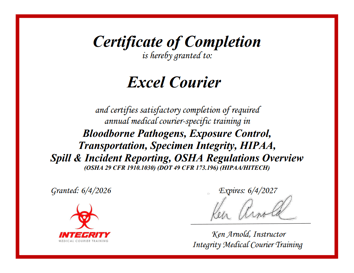 We supplement that with digital training through Integrity Medical Courier Training, including topics such as HIPAA and bloodborne pathogens.
But we don’t stop there. Drivers receive hands-on, scenario-based training around the situations they may encounter in the field, including specimen handling, lockbox procedures, and hospital workflows. Our on-site training facility gives us a place to work through those scenarios during onboarding and return to them for refresher training.
What we can do is give drivers a solid foundation, let them practice before the stakes are real, and reinforce one of the most important habits in medical logistics: Pay attention. And when something doesn't look right, ask.
If you're interested in learning more about our Medical Courier Services or how we train our drivers, contact us today.

About Integrity Medical Courier Training
Integrity Medical Courier Training has been training couriers since 2004, with experience in healthcare dating back to 1980. Their training is built specifically around medical courier work, including specimen handling and transportation, HIPAA, bloodborne pathogens, spill and exposure procedures, and other situations couriers and dispatchers may encounter in the field.
Today, Integrity offers online courses, live webinars, and on-site training for individual couriers and companies.
Want to learn more from Ken and the Integrity team?